LegacyGuard Wireless Extension (PIR wireless repeater)
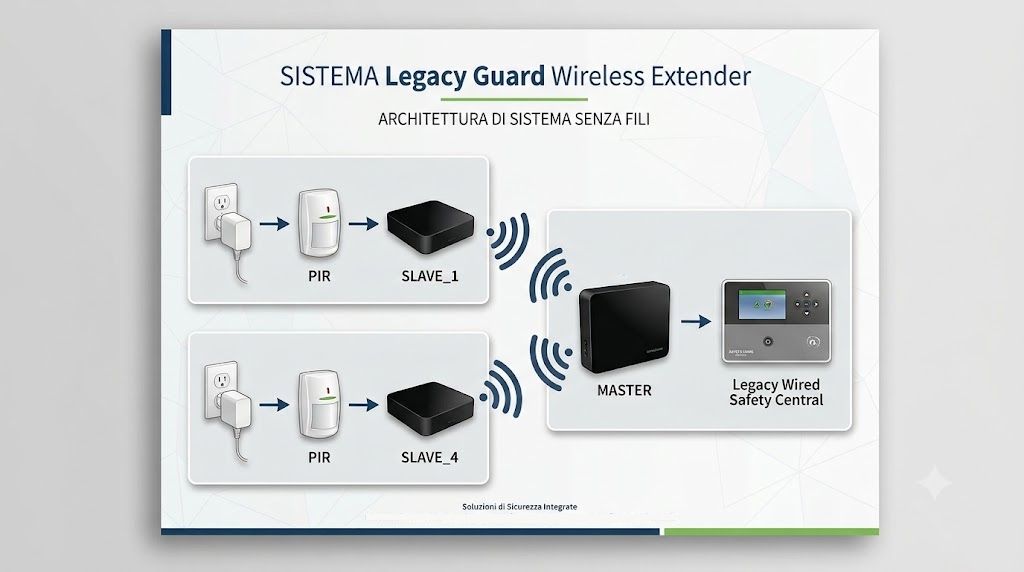
LegacyGuard Wireless Extension (PIR wireless repeater)
Want to add new sensors to your wired alarm system... without running cables? LegacyGuard Wireless Extension is the system I designed to expand any wired alarm control panel by adding new sensors with no masonry work at all.Why it's brilliant:
- Zero masonry work: no conduits, no holes, no plaster or paint repairs
- Compatible with any wired control panel: no need to replace anything, it integrates as a normal input
- Add PIRs, NC contacts and special sensors: each slave manages the input you need, from a simple magnetic contact to a volumetric sensor
- Perfect for already finished or renovated homes, exactly where work would be most expensive and disruptive
- Extremely fast installation: usually just a few minutes per slave
- Expandable over time, up to 4 slaves per master
The problem
How many times have you thought: "A sensor would really be useful here"... and then given up because running cables through the whole house is a nightmare? Visible conduits, holes in freshly painted walls, half a day of invasive work just to add a single magnetic contact on a window. The end result is always the same: you give up, and that point remains unprotected. A corridor without a PIR, a rear window without a contact, a technical room that nobody ever wanted to drill to run a two-wire cable.How it works
The idea is as simple as it is effective: a Wi-Fi-based master module communicates with small slave modules (from 1 to 4 per master), which you can install exactly where needed, even several metres away from the control panel. Each slave connects to the sensor with just a few centimetres of cable (enough to reach the PIR or magnetic contact in the same box) and is powered by a small 12V plug-in power supply, with no need to run the control panel's bus line all the way there. From that moment on, the slave module sends the sensor status via Wi-Fi to the master, which translates it into a signal on the wired terminal connected to the control panel. For the control panel it is as if there were a traditional wired sensor: closed zone, clean contact, no difference. It believes it has a new wired input. You haven't run a single metre of cable. The complete project, with firmware, PCBs and schematics, is available on the project's GitHub repository.Technical note on range
I tested this system in an apartment reaching 7 metres of distance from the master to the slaves.System testability via Telnet (from smartphone)
The system is fully inspectable remotely without needing to connect the board via USB: simply connect with your smartphone to the master's WiFi network (your customised SSID) and open a Telnet session to 192.168.4.1:2323 with any Telnet app for Android/iOS (e.g. Termius, JuiceSSH). After authentication and entering the diagnostic menu (m), the following tests and information are available, all accessible on the move:- Hardware board reset (command 0): useful for forcing a clean reboot without disconnecting power
- Firmware source file name (1): to quickly check which version is running
- Detailed statistics (2): number of detected alarms, successful and failed calls for each slave
- Extended diagnostics / tracing (3): can be activated on the fly to follow the internal behaviour of the firmware in real time
- Continuous presence/absence scan (4): shows in real time which slaves are responding and which are not
- Activation of Web OTA mode (5): to start a remote firmware update without opening the board
- Board MAC address (6): required to request customised network credentials
Master display and LEDs
Even without opening the Telnet console, the master provides an immediate overview of the system status thanks to the OLED display (which shows in real time the synthetic status of each of the 4 slaves: present/absent, normal/alarm) and the two edge LEDs, which respectively indicate polling activity at each cycle and the network scan/mapping phases.Advertising banners are a real nuisance, but if you just click on one of them, you will contribute, without spending a cent, to the maintenance of the server.
Categorie Articoli
Come-Trovare-Facilmente-l-Equivalente-di-un-Transistor
Corso-di-elettrotecnica-ed-elettronica-3-volumi
Libro-tutto-sull-audio---inglese
Libro-ELETTRONICA-FONDAMENTALE
Dove-acquistare-abbigliamento-risparmiando
Come-vedere-le-partite-sullo-smartphone
Come-difendersi-dagli-allegati-pericolosi-nelle-email
KEEPASS-un-posto-sicuro-per-le-nostre-PASSWORD
I-3-trend-estivi-del-2020-scopri-i-tagli-che-ti-stanno-meglio
Ultimi articoli
Remotino-Nano-Dual-Rail APRI
PIR-wireless-repeater APRI
Sensori-wireless-su-centrale-cablata APRI
Arduino-Debug-Facile APRI
Opta-Finder---PLC-Arduino-compatibile APRI
Servo-motore-a-due-posizioni-memorizzabili APRI
Nextion-Display-with-Arduino-Mega APRI
Display-Nextion-ed-Arduino APRI
Esp8266-Cloud-data-logger APRI
Un-disco-da-15-GB-gratis APRI
Come-copiare-1-TB-di-dati-su-WINDOWS APRI
Parallelatore-Camper APRI
Come-Trovare-Facilmente-l-Equivalente-di-un-Transistor APRI
Delaying-the-Switch-to-LPG APRI
Ritardare-la-commutazione-a-GPL APRI
OPTA-FINDER-ARDUINO-COMPATIBLE APRI
whatsapp-alarm-repeater APRI
Arduino_Template_Menu_Eng APRI
Arduino_Template_Menu APRI
Power-Supply-with-Current-Control APRI
Vantaggi_Alimentatori-Controllo_Corrente APRI
Camping-La-Secca-Moneglia APRI
Safety-Relays APRI
Rele-di-sicurezza APRI
Internal-or-External-Watchdog APRI
Watchdog-interno-o-esterno APRI
Ripetitore-di-allarme-su-Whatsapp APRI
Bufala-in-crosta APRI
Home-Automation-ESPeriment APRI
ESPerimento-Domotica APRI